Photo to be added
Kiana Ghaus
Chief Executive Officer
Details about Kiana will be added here: background, role in the project and areas of responsibility.
Because every life deserves pure water.
We treat toxic algal blooms in lakes, then check that the water has recovered and that people nearby breathe easier.
Project Bhagirathi is a student-founded company building one connected platform for harmful algal blooms. Sensor buoys watch the lake, a two-enzyme bead is designed to destroy the toxin at its source, and a safety interlock protects people downwind.
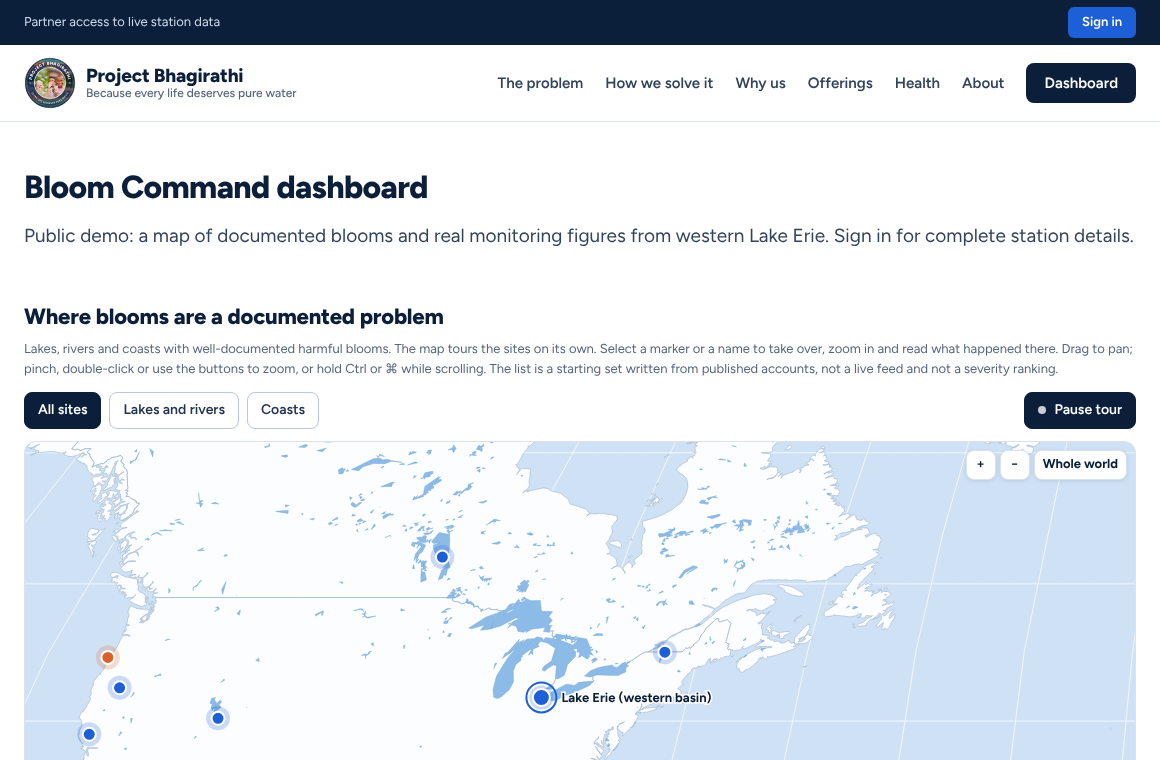
Open the dashboardHow it worksLakes and coasts with documented harmful blooms. The map tours them on its own; select any marker to take over.
Site resources: US EPA HAB monitoring and trends · NOAA Great Lakes data · Lake Erie monitoring paper · All references
What Project Bhagirathi is
We are a student-founded company. Most tools only watch a bloom. Ours is built in four connected parts, and each one triggers the next.
Sensor buoys and satellite indices read the lake continuously.
Buoy built and testedA model forecasts whether a bloom will turn toxic, 3 to 14 days ahead.
In developmentA two-enzyme bead opens the algae cell and destroys its toxin.
Designed, lab testing nextSensors confirm the water recovered. Air and wearable data track breathing symptoms downwind.
In developmentEvery treatment outcome is recorded and feeds back into the forecast.
Real monitoring figures from western Lake Erie, and a sample week at one of our buoy stations.
Tiles: real NOAA figures, 2012 to 2021. Chart: sample data in our buoy's format, not a real lake.
The problem the world faces
Cyanobacteria, or blue-green algae, are spreading in freshwater lakes. They release microcystin, a liver toxin. Waves lift it into the air, so it reaches people who never touch the water.
Since the 1980s
Intense summer blooms have increased in most large lakes studied worldwide.
Ho, Michalak and Pahlevan, Nature, 2019
1 µg/L
The WHO provisional guideline for microcystin-LR in drinking water. Bloom water can far exceed it.
2014
A Lake Erie bloom led Toledo, Ohio to tell residents not to drink their tap water.
Jetoo, Grover and Krantzberg, Sustainability, 2015
How we solve it
Breaking a cell open should make things worse, because that is what releases the toxin. It works only because both enzymes sit on the same bead.
Chitosan beads, made from shellfish shells, are released into the bloom.
Lysozyme on the surface breaks the cyanobacterial cell wall.
Microcystin escapes a few micrometres from the bead.
A toxin-degrading enzyme in the core breaks it down before it disperses.
The bead also binds phosphorus, the bloom's food, and is recovered afterwards.
The bead is designed and specified. Its removal figures are modelled from published enzyme studies; we have not yet run the laboratory tests ourselves.
Why we are uniquely positioned
Breaking open cyanobacteria also releases endotoxin, a known asthma trigger. Our platform compares how fast endotoxin is generated with how fast the beads capture it, and cuts its own dose when capture falls behind.
In one run the platform worked out 200 kg of beads.
How much will the treatment release, and how fast?
Can the beads absorb it at that rate?
Capture fell behind, so it sent 50 kg instead.
Nothing is released without a person approving it.
The interlock runs in our software today. Its coefficients still need laboratory calibration.
The integrated platform
What we have to offer
Views for water utilities, parks and lake managers, and health agencies.
Monitoring, assessment, forecasting, air and health, treatment, billing and reporting.
Software as a service, platform as a service, or a fully managed enterprise service.
Solving a health problem
+54%
Rise in emergency-room admissions for respiratory illness during a Florida red tide, in one hospital study of a marine bloom.
Kirkpatrick and colleagues, Harmful Algae, 2006
Microcystin has been measured in aerosol generated from bloom-affected lake water.
Olson and colleagues, Environmental Science and Technology, 2020
Alerts warn people with asthma first. After treatment, air-quality and wearable data show whether symptoms downwind actually fall.
What is measured and what is not
| Claim | Status today |
|---|---|
| Temperature, turbidity, dissolved solids | Measured by our buoy |
| Phycocyanin and microcystin levels | Estimated from proxies; no lab-grade probe yet |
| Bead toxin removal | Modelled from published enzyme studies |
| Bead release and recovery | Demonstrated at tub scale |
| Safety interlock | Running in software; needs lab calibration |
| Respiratory statistics | Other researchers' published studies, cited |
| Autonomous navigation, living-bacteria bead | Designed, not built |
Our mission
To give every community the means to see a harmful bloom coming, treat it safely, and know when their water and air are safe again, because every life deserves pure water.
About the company
The Bhagirathi is the Himalayan headstream of the Ganges. In legend, King Bhagiratha's long effort brought the river down to earth for his people. Project Bhagirathi takes that story as its purpose: bringing pure water back to the communities that depend on it.
We are a student-founded team building an integrated platform for harmful algal blooms. Today that means a sensor buoy built and tested, a working software platform, and a bead designed and specified. Laboratory validation of the bead is the current work.

Our integrated approach to bloom detection, treatment and health monitoring is the subject of a patent application that has been filed and is under examination.
The team
Chief Executive Officer
Details about Kiana will be added here: background, role in the project and areas of responsibility.
Chief Technology Officer
Details about Amisi will be added here: background, role in the project and areas of responsibility.
References
81 sources in nine groups. Select a group to open it.
The bloom sites on the map are a starting list written from published accounts, not a live feed. Our own results and their status are listed under About.